
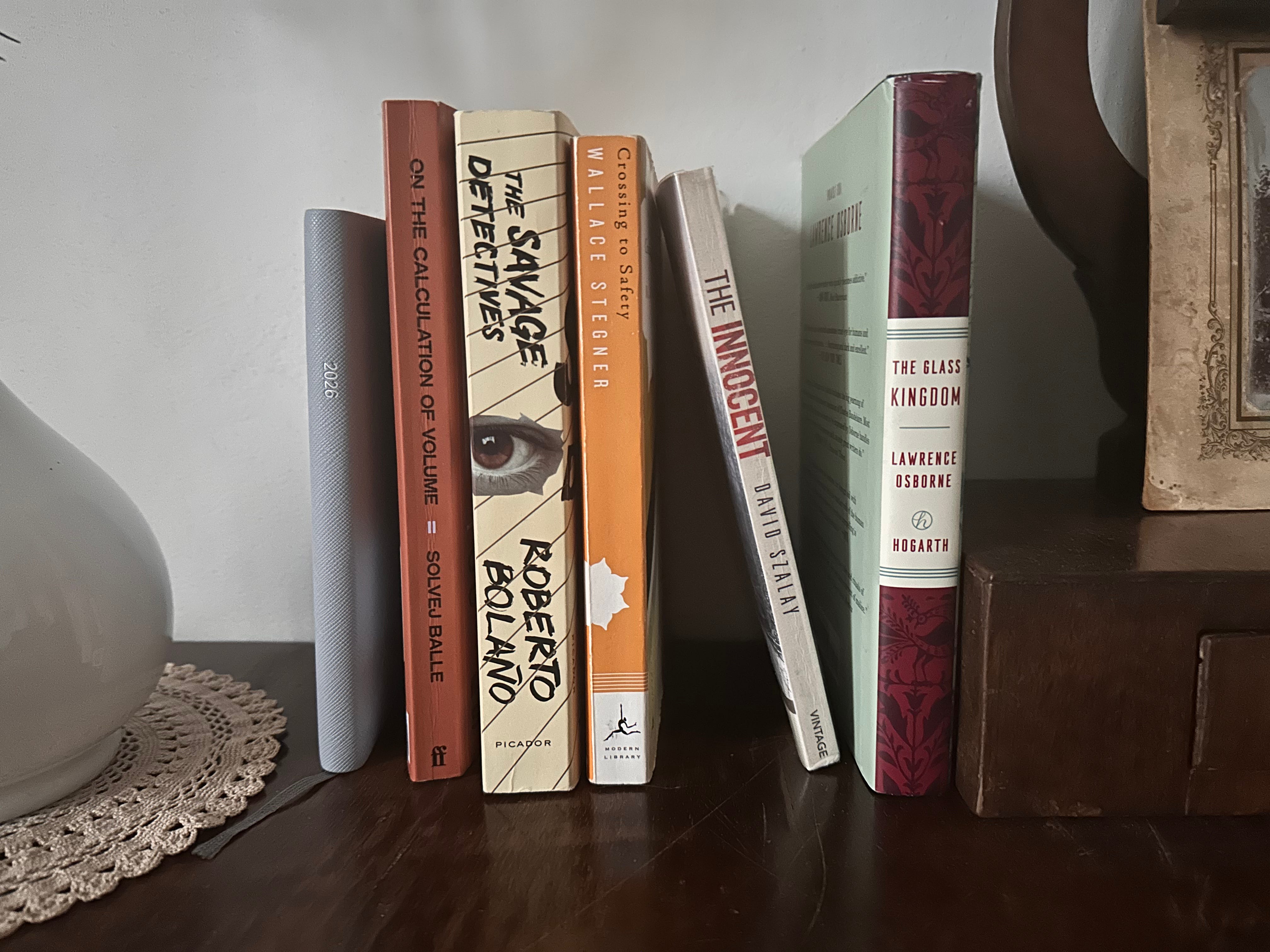
Only 46 books this year. I thought it'd be more. Maybe I’ll still get to 47, if I manage to finish Crossing to Safety in the next few days. It was a toss-up between Wallace Stegner and Roberto Bolaño, both of which had been sitting patiently on the bookshelf on the top floor of my mother’s house in Italy for years, waiting to be noticed and then for a hand to leaf, full of hope, to the first page. Back home, I’ve been informed chirpily by a solicitous bot, the book I really want to read next has been delivered into the hands of a neighbor and is waiting for me to return. I dislike the tone that bot takes me with me, but I am glad the book is waiting. I can’t wait to return to it, in fact. It is the third volume of a seven-part œuvre written by a Danish woman who lives on a remote island1 and is about a woman living the same November day over and over again. I can’t explain why it’s compelling and why it moves me almost more than anything else I’ve read this year. But it is and it has.
Whether it’s 46 or 47 books in the end, it’s still less than I was expecting. It’s okay, though. Everyone’s talking about 2025 and what a shit year it was. Globally, of course, I see it, I feel it, we all do, how could we not, but among my inner circle, it wasn’t an easy year, either, and then book-wise, too—a strange year of disappointing publications and fractured attention spans and the constant hum of disasters large and small emitting from our phones, distracting us, making us feel guilty for the comfort in which we live, the safety we take for granted, pulling us further and further from what we really want to do, who we really want to be. But 2025 was, for me personally, mercifully, a rather nice year, especially when contrasted with the abyss of 2024. The highlight was that I wrote the second draft of a novel, cutting 40,000 words from the original, restructuring it into a pleasing shape, propelling myself by sheer force to work day after day, without a contract and an editor and money and all the other bits of scaffolding that usually make work possible. I wasn’t sure I could do it and then I did. It’s a personal triumph that has carried me through all the rest of the year and its squabbles and petty resentments, one I hold on to like the smooth, dark rock, honed by centuries of crashing waves, that I keep in the pocket of one of my winter coats and am surprised to find each time I slip it on.
When I looked back over the list of books2 I read this year in anticipation of writing this newsletter, I was surprised by see Kelly Link’s The Book of Love at the top of the list. I thought I had read that book years ago, not less than 365 days ago. This is just one of the reasons I like keeping this list year after year. It functions as a very shorthand kind of diary and enables a bit of stock-taking at the end of the year. As my eyes ran down the list of books, I was reminded of the various moments throughout the year that were punctuated by books. There I am, sitting on the sofa with Hugo whilst reading Rejection, angling the book away from him so he couldn’t see what was making me laugh out loud. There are the bleak days of late winter when I read Jan Morris on Venice and Trieste and some Third Reich books. Oh, how I loved the breathless delight of tearing through Long Island, the satisfying heft of Dream Count, and, yes, right, there is the underwhelming triad of books I read, then left behind, in a rental house on the Isle of Skye.
This was the year I finally read The Wizard of Earthsea, so much darker and more adult than I had ever expected it to be. It was also the year in which I reread more than I usually do, mostly because I wanted to keep Hugo company as he discovered Diana Wynne Jones and Josephine Tey, and then because I was lying on the couch one day and Atonement was at eye level and I remembered reading it for the first time back when I was an editor at Abrams and I was so engrossed by the book that I kept reading it on the train to work in the morning and kept reading it while I walked all the way down Seventh Avenue from Penn Station to 18th Street and kept reading it under the desk in my office like a furtive schoolgirl and it felt like the entire world had fallen away and all that was left on this earth was that book and I. And I wanted to feel that again.
There were more than a few frustrating books, ones that bugged me in their unedited messiness, ones that felt like they weren’t meant to be published yet, would have benefited from more editorial input, ones that should have been shorter, ones that made me despair about publishing, about what our phones are doing to our ability to read deeply, to lose ourselves in the pages of a book, and what the past five years have done to the industry. I was unhappy in different ways about books that I had been desperate to read. Patricia Lockwood’s Will There Ever Be Another You? felt impenetrable in a way her others hadn’t. Lily King’s Heart the Lover felt brittle and false in a way her others hadn’t. Was it them or was it, I began to wonder, me? But there were surprises to be found, too, in Sally Mann’s entertaining, conversational Art Work and in In the Company of Men and The Search Warrant, both of which had been slumbering on my bookshelves for years, both of which were a revelation in their own way.
Then, towards the end of the year, my father gave me a copy of Solvej Balle’s first volume of On the Calculation of Volume. He wasn’t sure he could put his finger on why he liked it so much, but he did. It was interesting, a woman reliving the same day over and over again. Nothing really happened and yet he couldn’t put it down. My father and I don’t usually enjoy the same books, but I adore time loop stories. (See Life After Life and the fact that I can’t stop rereading it, this year, too.) I began reading it and felt the same thing my father did. A certain fascination, but also an inability to say exactly why it was so engrossing. But one thing I felt quite certain of, namely that it was a blessed relief that I could finally allow myself to get lost in a book again, trusting an author to transport me, letting her spell unwind itself around me. Why was it that this strange little book was able to do that while so many others this year felt so impossible to like?
I have a few theories, some of which began to come into focus as I read the second volume, but I’ll keep those to myself for now. It’s Christmas after all and there are other things we all want to do. These are precious days, the quiet in-between the years, as the Germans say, when time loses its urgency and even a bit of its meaning. The days flow one into the next, punctuated only by meals, by games, by visits with friends, by indulgences big and small. We are allowed to retreat into ourselves, to spend hours doing nothing without judgment, to lay plans for the coming year in creamy blank notebooks, to feel a sense of anticipation and hopefulness for what’s to come, to bask, if only briefly, in the delight of being present in this fleeting moment.
Merry Christmas, everyone.
Books I Read in 2025 (* are for the ones I liked more than others)
The Book of Love by Kelly Link
Piglet by Lottie Hazell
Rejection by Tony Tulathimutte*
Hot Milk by Deborah Levy
How to do Nothing by Jenny Odell
Venice by Jan Morris*
The Lives of Christopher Chant (now part of The Chronicles of Chrestomanci) by Diana Wynne Jones (reread)*
Trieste and the Meaning of Nowhere by Jan Morris*
German Autumn by Stig Dagermann*
They Thought They Were Free by Milton Mayer
Dogsbody by Diana Wynne Jones (reread)*
Wandering Stars by Tommy Orange
Long Island by Colm Tóibín*
Dream Count by Chimamanda Ngozi Adichie*
The Daughter of Time by Josephine Tey (reread)*
Habitations by Shila Sundar
Perfection by Vincenzo Latronico*
Orbital by Samantha Harvey
Life After Life by Kate Atkinson (reread)*
Martyr! by Kaveh Akbar
Show Don’t Tell by Curtis Sittenfeld
The Principles of Uncertainty by Maira Kalmna
The Netanyahus by Joshua Cohen
In Memoriam by Alice Winn
Nora Webster by Colm Tóibín
Consider Yourself Kissed by Jessica Stanley
A Wizard of Earthsea by Ursula LeGuin*
Atonement by Ian McEwan (reread)*
On Earth We’re Briefly Gorgeous by Ocean Vuong
HHhH by Laurent Binet
Loved and Missed by Susie Boyt
Larry’s Party by Carol Shields
Art Work by Sally Mann*
Die Vermessung der Welt by Daniel Kehlmann*
The History of Sound by Ben Shattuck
Heart the Lover by Lily King
What We Can Know by Ian McEwan
Will There Ever Be Another You? by Patricia Lockwood
On the Calculation of Volume I by Solvej Balle*
The Waitress was New by Dominique Fabre
In the Company of Men by Véronique Tadjo*
The Search Warrant by Patrick Modiano*
The Glass Kingdom by Laurence Osborne
The Innocent by David Szalay
On the Calculation of Volume II by Solvej Balle*
Gift link
Almost all the book links are affiliate.
I read Batuman’s novels out of order; you should read The Idiot first, then Either/Or.
I so appreciate the care and thoughtfulness with which you curate these lists and observations. I find that sense of calm inquisitiveness so reassuring in these turbulent times, and appreciate the solace of your newsletters so much!
May this dwindling year and the promise of the next bring to you and yours the many blessings you share with others.
I am so happy to see that you didn’t love Heart the Lover, either. I think we are the only two people on earth who didn’t! Having said that, I enjoyed The Correspondent but didn’t ‘love’ it. I do love reading your book list every year, though. Thanks for sharing!